
Unpaid Carers

Who is an unpaid carer?
At Blue Sky Social Care Card, we recognise an unpaid carer as someone who provides regular care, support, supervision or assistance to another person because of their disability, illness, long-term health condition, mental health needs, age or other support needs, without being paid to provide that care.
Caring can take many different forms. It may include personal care, practical support, emotional support, helping with medication, attending appointments, managing finances or correspondence, coordinating services, providing supervision, or simply being there when someone needs you.
There is no minimum number of hours required to be an unpaid carer. Caring does not happen on a stopwatch, and the impact of caring cannot always be measured by the number of hours spent providing hands-on care.
Who can be recognised?
The Blue Sky Social Care Card is intended to recognise a wide range of unpaid caring roles, including:
- Parent carers supporting a child or young person with additional needs, disabilities or a health condition.
- Young carers who provide care or support to a family member.
- Adult carers supporting a partner, relative, friend or neighbour.
- People supporting friends who rely on them because of illness, disability, mental health needs or another support need.
- Working carers who balance employment with their caring responsibilities.
- Hidden carers who may not identify themselves as a carer or receive formal support but regularly provide unpaid care.
You do not need to receive Carer’s Allowance or have completed a formal Carer’s Assessment to be recognised. Formal documentation can help with verification, but we understand that many genuine carers do not have this type of evidence.


What does the Blue Sky Social Care Card do?
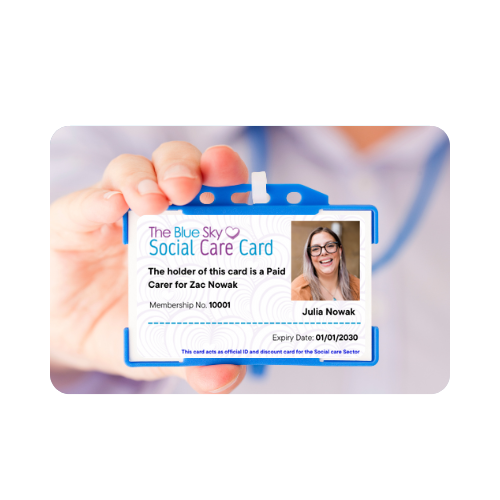
The Blue Sky Social Care Card provides recognition and verification of an individual’s unpaid caring role.
It gives cardholders a simple way to demonstrate that their caring role has been verified through our application and evidence-checking process.
The card can help carers:
- Explain their caring role more easily.
- Feel recognised for the contribution they make.
- Access carer-related discounts, concessions and offers where participating organisations choose to provide them.
- Avoid repeatedly having to explain their circumstances in situations where evidence of their caring role may be requested.
- Carry a form of recognised identification that confirms their verified caring status.
What the card does NOT prove
The Blue Sky Social Care Card does not prove or certify:
- The specific amount of care someone provides.
- A minimum or maximum number of caring hours.
- A person’s medical condition or diagnosis.
- The medical condition, disability or diagnosis of the person being cared for.
- Entitlement to Carer’s Allowance or any other benefit.
- Eligibility for social care or NHS services.
- Legal authority to make decisions on behalf of another person.
- That a business or organisation must provide a discount, concession or free entry.
Any discounts, benefits or concessions linked to the card are offered at the discretion of the individual business or organisation.
Protecting your information
We understand that verification involves sharing personal information and evidence, and we take this responsibility seriously.
Information provided as part of an application is handled securely and only used for legitimate purposes connected with verification, card administration, safeguarding against misuse and our legal responsibilities.
We do not expect applicants to provide unnecessary information. Evidence is assessed proportionately, and personal information is handled in accordance with our Privacy Policy and data protection requirements.
Fair, inclusive and proportionate recognition
We recognise that every caring situation is different. A carer may provide intensive hands-on care every day, while another may spend significant time coordinating appointments, managing medication, making phone calls, providing emotional support or responding to emergencies.
Both can be caring.
Our approach is therefore designed to recognise genuine unpaid caring relationships without imposing an arbitrary minimum number of hours or requiring every carer to fit the same definition of what caring looks like.
Unpaid Carer eligibility criteria
- Currently provide unpaid care, help or support to another person.
- Care for someone because of illness, disability, a mental-health condition, addiction, frailty or needs associated with older age.
- Have an ongoing or recurring caring responsibility—not simply providing a one-off favour or occasional informal help.
- Provide the care outside paid employment.
- Can demonstrate the caring relationship through acceptable evidence or enhanced verification.
- Complete the required identity, consent and fraud declarations.
There is no minimum number of caring hours. Eligibility is based on the genuine nature, responsibility and continuity of the caring role—not whether someone provides nine, 20 or 35 hours per week.
Examples of eligible caring responsibilities

- Personal care or help with daily living
- Medication support or oversight
- Attending or arranging appointments
- Transport to treatment
- Communication or advocacy support
- Managing correspondence, bills or finances
- Emotional support during distress or crises
- Supervision or safeguarding
- Support with mental health or addiction
- Remaining available for emergencies
Evidence applicants can provide
- A letter from a local authority, NHS service, GP, social prescriber or healthcare professional
- A letter or confirmation from a recognised carers organisation
- A carer’s assessment or relevant care-plan extract
- Hospital discharge correspondence naming the carer
- School or college correspondence confirming the caring role
- Carer’s Allowance or carer-element evidence, where applicable
- Verification from an approved professional or carers organisation
- Other official correspondence that clearly confirms the applicant’s caring role
- Evidence relating to the cared-for person, such as a Personal Independence Payment (PIP) or Disability Living Allowance (DLA) award letter, where the cared-for person's details have been provided on the application form and the evidence helps demonstrate the applicant's caring role.
You may qualify for the Blue Sky Social Care Card if you currently provide regular unpaid care, help or support to a family member, friend or another person because of illness, disability, a mental-health condition, addiction, frailty or needs associated with older age.
There is no minimum number of caring hours. We consider the nature, responsibility and continuity of your caring role rather than hours alone. You will need to provide suitable evidence so that our trained team can verify your unpaid-carer status.